
SC81 – STANDING COMMITTEE · GENEVA, 2–6 NOVEMBER 2026
Pernambuco and the CITES Standing Committee (SC81)
Key Takeaways at a Glance
- No immediate changes. SC81 adopted no new obligations. The rules in force since 5 March 2026 (Annotation #10, revised at CoP20) remain applicable.
- Work on traceability is underway. The Committee approved the terms of reference for a study on the traceability of bows, bow sticks and wood stocks. Measures under consideration include mandatory stock declarations before a specified deadline and individual bow registration.
- Proof of origin is becoming essential, both for existing wood stocks and plantation-grown wood.
- Decisions will come later: recommendations at SC82 (2027), followed by decisions at CoP21 (late 2028).
- Your priority: document your wood stocks now. Stocks that are properly inventoried and supported by evidence today will be much easier to have officially recognized in the future.
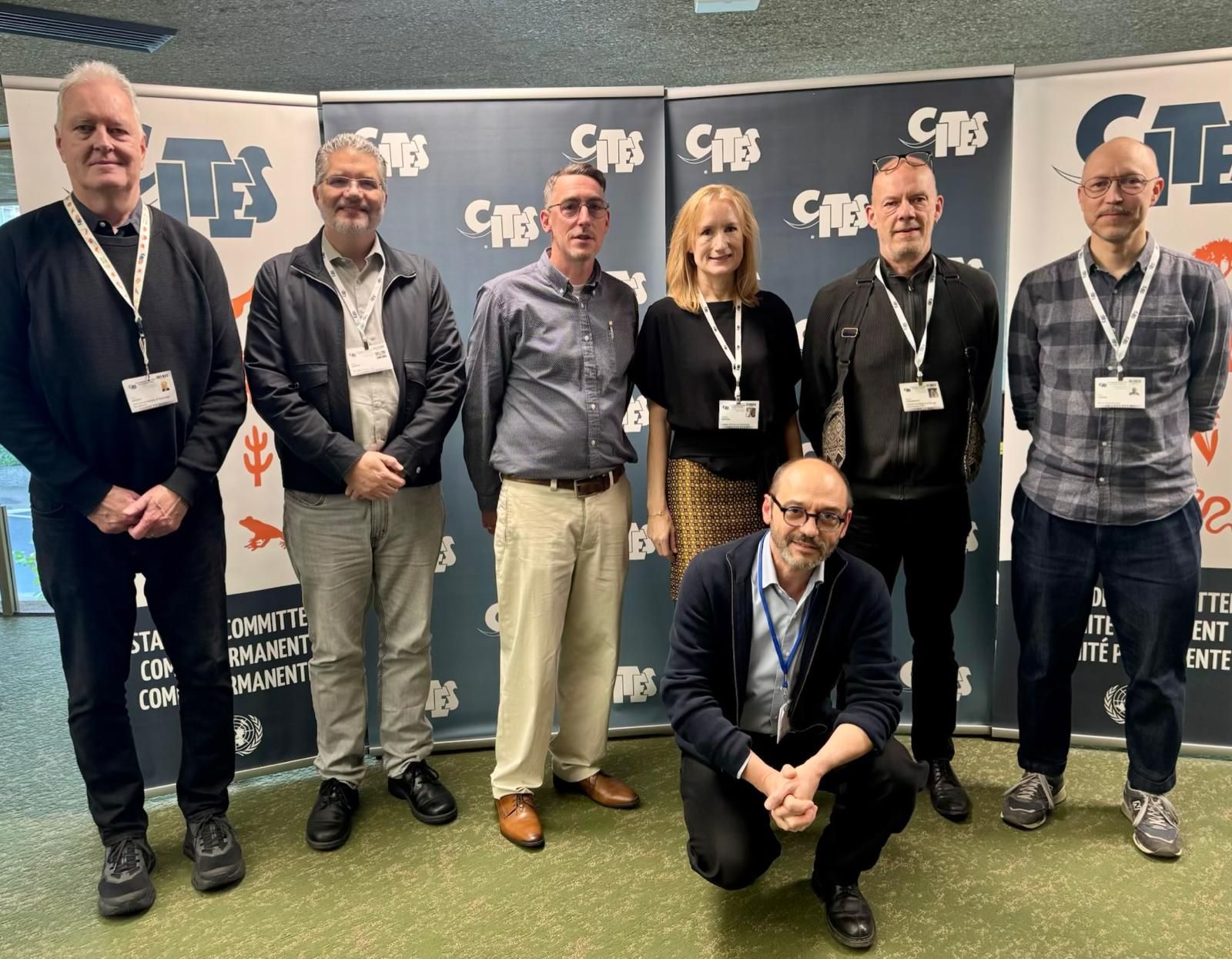
The music sector at SC81. From left to right: John Bennett (EILA, International Association of Master Luthiers and Bow Makers), Albert Germick (C.F. Martin & Co.), Michael Jousserand (European Soundmakers), Heather Noonan (League of American Orchestras), Jacques Carbonneaux (CSFI), Lauri Tanner (IPCI France Europe) and Arthur Dubroca (IPCI France Europe). Not pictured: Thomas Gerbeth (IPCI Germany), Gabriel Pasquier (IPCI France Europe) and Scott Paul (Taylor Guitars).
1. Pernambuco in the Plenary Session (Agenda Item 62)
SC81 Docs. 62.1 and 62.2 · Meeting summary SC81 Sum. 7 (Thursday, 5 November)
Report of the Working Group
The Standing Committee took note of the report of the intersessional working group chaired by Brazil (SC81 Doc. 62.1). The group will prepare its recommendations for SC82, taking into account comments from Brazil, France, Japan and the United Kingdom.
The Committee reminded Parties of the actions set out in Decision 20.239 (data on stocks, traceability and seizures), and the music sector of those set out in Decision 20.243: funding studies, implementing harmonized traceability systems, supporting conservation and research, and raising awareness. It invited Parties and the private sector, including the music industry, to contribute financially to this work. No in-session working group was established during SC81.
Traceability Study: Terms of Reference Approved
The study (Decision 20.240 c) ii)) will address the traceability of bows, bow sticks and pernambuco wood stocks. In particular, it will examine the following issues to enable the Standing Committee to formulate recommendations for the next Conference of the Parties (CoP):
- Physical marking of bows: unique serial numbers, engraving or laser marking, and photographic identification of the wood grain at the end of the bow stick;
- Digital registers of wood stocks and bows, and the concept of a "bow passport" proposed by the sector;
- Tracking the transformation of wood stocks, from logs to unfinished bow sticks and then finished bows (production records, photographs and records of quantities used);
- Mandatory declaration of stocks before a specified deadline;
- Links with CITES permits;
- Scientific methods for verifying wood origin (mass spectrometry, isotope analysis and DNA analysis).
The terms of reference also require the study to distinguish between three categories of bows:
- Bows made from wood harvested before 13 September 2007 (the date on which pernambuco was listed under CITES), which may qualify for pre-Convention status;
- Bows made from wood legally acquired after that date;
- Bows for which the date of acquisition or the legal status of the wood cannot be reliably established.
N.B.: Some countries distinguish between additional categories, for example by identifying Brazilian bows separately.
The text acknowledges that registering the millions of bows already in circulation would be impracticable. However, it does not rule out registering pre-Convention stocks, bow sticks and wood intended for bow making. Brazil, for its part, considers that documentation alone is insufficient and advocates a physical link between the wood and the finished bow.
The estimated cost of the study is between US$30,000 and US$50,000. Its scope will depend on the funding secured. France requested a proportionate approach, taking into account available resources and time constraints. The findings will inform the recommendations submitted to CoP21.
Study on Conversion Factors
The study on conversion factors between wood, bow sticks and finished bows (Decision 20.241) was not discussed at SC81. It falls within the remit of the Plants Committee, which adopted its terms of reference at its 28th meeting (PC28). The study will probably be considered at PC29 in 2027.
IMPORTANT: The IPCI network has launched a survey on how professionals assess the quality of pernambuco wood used in bow making, as well as the quality of wood in the trade in antique bows.
It is extremely important to respond to this survey, as the results will contribute to ongoing work aimed at establishing a conversion factor between existing wood stocks and the number of bows that can be made from them. https://pau-brasil.info/
WHAT THIS MEANS FOR YOU
There are no new obligations at present, but the direction is clear: declared wood stocks, identifiable bows and traceable production processes.
The category of wood whose origin cannot be established is likely to create difficulties in the future. Any evidence of dates and legal origin that you can gather now will help protect your interests.
If a deadline for mandatory stock declarations is introduced, stocks that remain undocumented by that date may become difficult to use, sell or export.
2. Proving the Legal Origin of Wood (Agenda Item 43)
SC81 Docs. 43.1 and 43.2 · Meeting summary SC81 Sum. 4 (Tuesday, 3 November)
The working group on legal acquisition findings (LAFs), whose work concerns all exotic woods used in musical instrument making, has been extended until SC82.
Its revised mandate focuses on the concepts of "founder stock" (1) and "parental stock" (2): how far back must documentation go, and what evidence is required to demonstrate that an artificially propagated or captive-bred specimen is of legal origin?
The adopted text refers to chronological documentation being required "to the extent possible and in accordance with applicable laws and records."
For pernambuco, for example, the key issue is plantation-grown wood, which represents a potential future source of supply.
Since CoP20, Annotation #10 has established a zero export quota for wild-sourced specimens (source code W) traded for commercial purposes.
If a strict interpretation prevails, it could become necessary to demonstrate the legality of seeds collected more than 20 or 30 years ago to produce plants subsequently grown in nurseries.
The music sector advocates an approach specifically adapted to plants, based on the concept of "cultivated parental stock" established in Resolution Conf. 11.11, with evidence requirements proportionate to the risks involved.
The issue will also be addressed at the technical workshop on specimens from non-wild sources (Decision 20.145), in which the CSFI and European Soundmakers are registered to participate.
(1) Founder stock: The original specimens collected from the wild (seeds, seedlings or animals) from which a plantation or breeding operation was established. CITES has not yet adopted a precise definition of this term; clarifying it is part of the working group's mandate.
(2) Parental stock: For plants, this refers to "cultivated parental stock" as defined in Resolution Conf. 11.11: the collection of plants grown under controlled conditions and used for reproduction.
Such stock must have been established in accordance with CITES provisions and national legislation, in a manner not detrimental to the survival of the species in the wild, and maintained so as to minimize the need for further collection from wild populations.
AN ISSUE FOR IPCI TO MONITOR CLOSELY
It is too early to draw practical conclusions for bow-making workshops.
Nevertheless, it is essential that IPCI and CSFI continue to monitor Agenda Item 43 through to SC82, both within the working group and during the workshop established under Decision 20.145.
The definitions ultimately adopted will determine the conditions under which pernambuco from plantations supported by IPCI can be recognized as a legal source of wood for bow making.
3. Other Issues Affecting Pernambuco and the Musical Instrument Sector
CITES Tree Species Programme (Agenda Item 24). The programme's 16 projects, including one concerning pernambuco, are continuing without change.
Traceability Systems for Tree Species (Agenda Item 44). No new general obligations have been introduced. Pernambuco-specific traceability remains under consideration within Agenda Item 62.
Demand Reduction (Agenda Item 29). The Committee encouraged Parties to share their demand-reduction strategies and identify markets where demand for illegally traded specimens is high, so that measures can be targeted accordingly.
It invited the Secretariat, subject to available resources, to publish case studies and support pilot projects involving additional Parties.
A report is expected at SC82 (SC81 Sum. 10).
Although the meeting summary does not specifically mention pernambuco, SC81 Doc. 29 identified it among the potentially priority timber species for such projects.
The sector will continue to monitor this issue closely.
International Travel by Musicians (Agenda Items 50 and 47). The Committee proposes extending the maximum validity of the Musical Instrument Certificate (MIC) to 10 years, using a harmonized certificate format, for consideration at SC82.
Each Party would retain discretion to determine the period of validity.
Purpose-of-transaction codes for non-commercial movements remain under discussion.
For further information on musicians travelling with their bows, see Section 5.
4. Meetings Held on the Sidelines of SC81
Brazilian Delegation : Representatives of the music sector (CSFI, IPCI France Europe, IPCI Germany, the International Society of Violin and Bow Makers, and the League of American Orchestras) met with three Brazilian representatives:
Claudia Maria Correia de Mello (IBAMA); Marcella Hermida de Paula (IBAMA);Larissa Karydakis, a diplomat from Brazil's Permanent Mission in Geneva responsible for the dossier.
Brazil asked the sector to provide financial support for the studies commissioned by the CITES Secretariat and emphasized the importance of maintaining dialogue.
The sector committed to contributing financially and encouraging Parties to do likewise once the costs were known.
It also proposed regular exchanges by videoconference.
The discussions took place in a cordial and open atmosphere.
CITES Secretariat : CSFI asked the Secretariat about the procedure for enabling the music sector to contribute financially to the two studies agreed upon at CoP20. Contact has been established, and a response is awaited.
European Union and Member States : European Soundmakers presented the sector's position on pernambuco (Agenda Items 62.1 and 62.2) during the EU stakeholder meeting.
This meeting took place at the same time as the discussions with the Brazilian delegation.
Information Document Submitted by the Sector
The music sector submitted an information document on pernambuco (SC81 Inf. 43) through France.
John Bennett, representing the International Society of Violin and Bow Makers, addressed the plenary session on behalf of the sector.
5. Informing Musicians and Orchestras
Decision 20.243 (CoP20) · Recalled by the Committee under Agenda Item 62.1 (SC81 Sum. 7)
Among the actions requested of the music sector under CoP20 Decision 20.243 is raising awareness among musicians and orchestras.
The Standing Committee reiterated this responsibility at SC81.
This is an area in which the sector can take action immediately, without waiting for CoP21.
What Musicians Need to Know
Since 5 March 2026, Annotation #10 has also covered finished bows.
Only bows transported for non-commercial purposes remain exempt, and solely in the circumstances specified in the annotation:
- For performances, whether paid or unpaid;
- For personal use;
- For exhibitions, loans or competitions;
- For educational purposes, evaluation or repair.
In all cases, the movement must not involve a change of ownership, including the sale, transfer or disposal of the bow outside the owner's country of usual residence.
Musicians must therefore be able to demonstrate that the movement of their bow falls within one of these exemptions and that all materials incorporated into the bow may be transported in compliance with CITES requirements.
To this end, they should take the necessary steps now to document their pernambuco bows by contacting their bow maker.
THE ROLE OF BOW MAKERS
Bow makers are particularly well placed to inform musicians and orchestras: they know the bows, their owners and their histories.
In practical terms, you can:
- Provide documentation with every bow sold, describing the bow (maker, date, materials and photographs) and establishing its lawful acquisition and legal origin;
- Issue personalized material declarations upon request, using the template available at ipci-france-europe.org;
- Use repair and rehairing appointments as opportunities to inform clients and document bows that do not yet have adequate records;
- Share information with orchestras, conservatories and music schools.
6. Our Recommendations for Bow Makers
ACTIONS TO TAKE NOW
- Complete your stock inventory: Include logs, sawn timber, unfinished bow sticks, worked bow sticks and finished bows, together with their quantities.
- Gather evidence of origin and dates: Collect invoices, certificates, import permits, previous declarations and dated photographs. This documentation will help establish whether wood qualifies as pre-Convention (harvested before 13 September 2007) or was otherwise legally acquired.
- Maintain production and stock records: Establish a system linking each bow to the specific batch of wood from which it was made.
- Identify newly made bows: Use serial numbers, physical markings and photographs, anticipating the options being examined in the traceability study.
- Obtain the necessary CITES permits for sales outside the EU: Since 5 March 2026, contact your regional CITES authority (DREAL in France) to obtain the permits required for international commercial transactions.
- Inform musicians and orchestras: Explain the exemptions provided under Annotation #10 and help clients document their bows.
- Report practical difficulties: Inform IPCI France Europe of any problems encountered, including blocked shipments, rejected evidence or difficulties arising from the regulatory changes introduced on 5 March 2026.
- Support CITES studies and conservation programmes: A fundraising campaign entitled "One Donation for Tree and Music" will be presented shortly.
7. Next Steps
- Late 2026 – Study on the assessment of pernambuco wood quality.
- 2027 – Implementation of the traceability study, subject to funding.
- 2027 – 29th meeting of the Plants Committee (Indonesia has offered to host PC29): the study on conversion factors is likely to be considered.
- Week of 8 November 2027 – SC82 in Geneva: recommendations from the pernambuco working group and further consideration of legal origin requirements.
- Late 2028 – CoP21 (Panama) – Decisions concerning traceability and the regulatory framework for pernambuco.
REFERENCE DOCUMENTS
IPCI FRANCE EUROPE ASSOCIATION - 3 rue Truffaut 75017 Paris - Association number: W751269309


