
INFORMATION FOR MUSICIANS
Introduction to the factsheet – Musicians and Pernambuco bows
As of 5 March 2026, the application of annotation #10 (Rev. CoP20) of the Convention on International Trade in Endangered Species of Wild Fauna and Flora (CITES) will result in a revision of the rules applicable to bows made of pernambuco (Paubrasilia echinata), particularly for musicians who travel or sell their bows.
The attached practical information sheet aims to present in a simple manner the rules applicable when crossing borders, distinguishing between non-commercial movements, which concern the majority of musicians' travel, and commercial movements, which are subject to a stricter documentation regime.
1. Non-commercial travel by musicians
In the vast majority of situations, musicians travelling with their bows do so for non-commercial purposes. Annotation #10 (Rev. CoP20) provides that such movements may be carried out without a CITES certificate, under certain conditions.
Within the European Union, no CITES certificate is required to travel with a pernambuco bow.
Similarly, for non-commercial travel outside the European Union, no certificate is required, provided that the purpose of the trip is for personal or professional use not involving a commercial transaction.
This includes the following situations:
- paid and unpaid performance,
- personal use,
- display,
- loan,
- competition,
- teaching,
- appraisal, or
- repair.
In these cases, musicians must simply be able to justify the non-commercial purpose of their travel in the event of an inspection.
This provision aims to guarantee the movement of musicians and the dissemination of music, while maintaining the species protection framework provided for by CITES.
2. Commercial movements of bows
However, when a bow is the subject of a sale or commercial transaction, the rules are different.
Within the European Union, no CITES certificate is required for the sale of a pernambuco bow, as the species is listed in Annex B of European regulations (equivalent to CITES Appendix II).
However, for transactions involving a country outside the European Union, a CITES permit is required to export or import the bow.
This is the case, for example, for trade between France and third countries such as the United Kingdom, Switzerland, Japan or the United States.
3. The importance of keeping supporting documents
Even if you do not have any immediate plans to sell, it is strongly recommended that you keep or gather all documents that establish the status of the bow, including:
- an invoice or any document certifying ownership of the bow prior to 5 March 2026,
- a declaration of materials,
- a certificate of authenticity or proof of age.
These documents may be necessary to obtain a CITES certificate in the event of an international transaction.
4. Other protected materials
Finally, it should be noted that some bows may also contain other materials listed in the CITES appendices, such as ivory, tortoiseshell or whale baleen, which are subject to CITES permits.

FORM AND GUIDE FOR MUSICIANS BY FIM AND PEARLE*
If your instrument contains material protected by the Convention on International Trade in Endangered Species of Wild Fauna and Flora (CITES), careful preparation is required. The guide produced by FIM and PEARLE aims to provide musicians, ensembles, bands and orchestras with practical information on the regulations in force and on obtaining CITES certificates, such as the Musical Instrument Certificate (MIC), before setting off on tour or for other professional reasons.

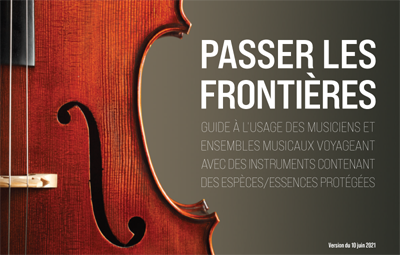
Download the guide by clicking on the image above, or fill in the form according to your profile and request by clicking on the button opposite.
Is a CITES certificate required to travel with a musical instrument?
The simple answer is "sometimes, yes". To avoid any problems, it is advisable to prepare well for any trip involving the crossing of borders with a musical instrument. As the rules of the Convention on International Trade in Endangered Species of Wild Fauna and Flora (CITES) become stricter, and the number of protected species increases, you may need a CITES certificate. And if it's not the case today, it may be tomorrow.
Visit fIM and PEARLE* associations you offer you a short questionnaire to help you :
- check, depending on your destination, whether the materials in your instrument require a CITES certificate (CIM* or CEI*);
- identify the steps to be taken before your departure.
Musical Instrument Certificate (CIM)
CIM (Musical Instrument Certificate)
Valid for three years and multi-purpose, this CITES certificate is dedicated to travel with musical instruments. It replaces the traditional CITES import and export documents.
The CIM must be stamped at each border crossing by a duly accredited CITES inspector (an ordinary customs employee does not necessarily have the authority to validate the certificate).
CEI (Certificate for Traveling Exhibitions)
Initially reserved for museums, it has been available to orchestras since the 16th CoP (2013). All instruments transported together can now be registered on the same CEI (instead of one CIM per instrument).
As its use is not harmonized within the European Union, please ensure that the CITES authority in the country of departure issues this certificate.
N.B.: The UK does not issue CIMs to bands, orchestras or ensembles. British musicians traveling as a group must therefore apply for a CIM individually before departure.
Differences between CIM and IEC
The CIM is issued for a single instrument. It lists all the protected species present on the instrument. The application for a CIM can be made by the owner or holder of the instrument, or by the ensemble or orchestra with which the musician is traveling. An instrument registered on a CIM can be carried in the hold or as hand luggage.
The CEI is suitable for musical ensembles and orchestras. A single IEC is sufficient for all instruments traveling with the same ensemble. Its cost can be lower than the cumulative cost of all individual IRCs, but the instruments listed on the IRC cannot be separated and must be placed together in the hold. It is forbidden to isolate an instrument listed on the IRC to transport it as hand luggage, or to leave the group to continue the journey alone with this instrument.
Both the CIM and the CEI can be used several times, and are valid for three years.
MULTIPLE INSTRUMENTS if you're traveling alone and carrying more than one instrument at a time, you can apply for a CIM for each instrument, or, if you own all the instruments you're carrying, a Certificat pour Exposition Itinérante (CEI). An IEC can be useful if you're traveling with a large number of instruments. However, a CIM for each instrument is preferable if the instruments concerned are not all being transported together on the same trip.
IPCI FRANCE EUROPE ASSOCIATION - 3 rue Truffaut 75017 Paris - Association number: W751269309


